Barcelona
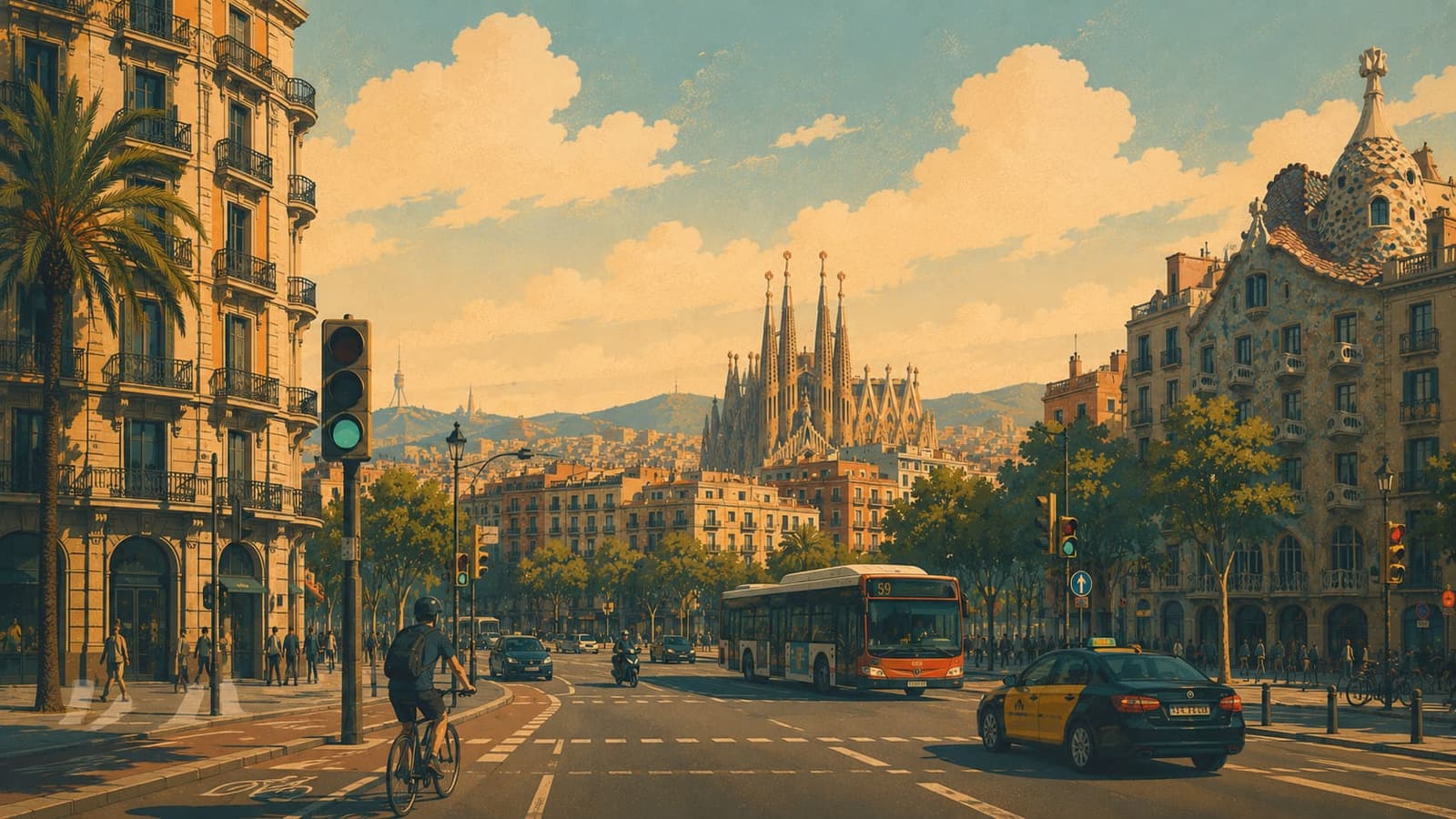
Illustration: 1001 Smart Cities
🇪🇸

Barcelona

Country
Spain
Population
1.6M
Projects
20
First project
1992
Track record
2 scaled back
Best evidence
Peer-reviewed
Last verified
27 August 2026
In the atlas since
15 July 2026

🤖 AI-generated city profile, summarising the source-checked entries below — how this works

Barcelona's smart move is deliberately low-tech: the superblock, which diverts through-traffic to the perimeter and hands the inner streets back to people. The 2016 Poblenou pilot used cheap tactical paint before anything permanent and cut inner-street traffic 58%; Sant Antoni carried the idea into a dense market district in 2018, where the city's health agency measured a 25% drop in NO2. Yet that low-tech turn followed a decade as one of the world’s most-copied sensor-and-IoT smart cities — Barcelona has worn both hats.

The atlas documents 20 projects in Barcelona, the earliest dating to 1992: 16 with a documented success, 2 scaled back, 2 still running without a verdict. Every entry carries an evidence grade — the strongest here is peer-reviewed (4 entries) — and links its sources.

Start here

Three entries that show what Barcelona is actually doing.

The shape of Barcelona

Computed from the 20 entries below — a profile, not a score.

Outcome succeeded 16ongoing 2scaled back 2
Evidence peer-reviewed 4independent 2official 12media 2

How Barcelona got smart

Barcelona's digital groundwork predates the word “smart city.” In 2013 the city put on-street parking payment on the phone with ApparkB, later adding a data-driven prediction layer without ever installing a citywide sensor network — a pattern of choosing data and process over hardware that recurs throughout the city's projects. In February 2016 it went further, building and open-sourcing Decidim, a participation platform that Barcelona still runs its own multi-hundred-million-euro budgeting process on and that dozens of other governments, from Helsinki to France's National Assembly, now use too. The same year, the city began VinclesBCN, lending tablets to isolated older residents and pairing them into facilitator-run social groups — a rare case of a city building tech-enabled social care rather than traffic or utility infrastructure.

But Barcelona’s global smart-city fame was built on sensors, not paint — and it started earlier. The 22@ innovation district (2000) rewired industrial Poblenou with fibre, pneumatic waste and district cooling, becoming the city’s living lab; on top of it the city built Sentilo (2013), an open-source sensor platform other cities copied, and wired sensor lampposts and in-ground parking sensors (2011) into showcase pilots. Not all of it stuck: the parking sensors were quietly wound back around 2020 in favour of cheaper payment-data prediction, an SFpark-style lesson.

Barcelona's best-known move, the superblock, arrived in 2016 too: the Poblenou pilot used cheap tactical paint to divert through-traffic to a district's perimeter and cut inner-street traffic 58%, and by 2018 the idea reached a dense market district at Sant Antoni, where the city's own health agency measured a 25% drop in NO2. The city tried to scale the concept citywide from 2022 with Green Axes Eixample, rebuilding four Eixample streets into green pedestrian axes — but only four of roughly twenty-one planned axes were ever built. The Collboni administration elected in 2023 ruled out further expansion on cost grounds, and a court has ordered part of the flagship Consell de Cent axis reverted over a planning-procedure defect, a ruling the city is still appealing. The superblock is Barcelona's clearest smart-city export, but its own city is the case study in how hard it is to finish scaling one.

When the city government changed in 2015, the emphasis shifted — from vendors and sensors toward citizens and their data. Open Data BCN (2011) had already opened hundreds of datasets; the city now leaned into data sovereignty with the EU DECODE pilot (2017–19), letting residents control what they shared and feeding Decidim. The same ethos powered citizen science: Smart Citizen kits and the xAire campaign put air-quality monitoring literally in residents’ hands.

Mobility and resources filled in around the superblocks. Bicing bike-share (2007, now largely electric) and the demand-designed Nova Xarxa orthogonal bus grid (2012–18) reshaped how people move, while the long-delayed T-mobilitat contactless fare system finally replaced paper tickets by 2026. Underground, Envac’s pneumatic waste tubes (since 1992) and telemanaged park irrigation (2014, Sentilo-fed) quietly cut trucks and water use.

The more recent projects are quieter infrastructure catching up with the city's ambitions. The ZBE Rondes de Barcelona low emission zone has restricted polluting vehicles across the metropolitan ring roads by camera since 2020, with an independent peer-reviewed study finding a measurable NO2 drop — though it briefly went dark in early 2026, suspended during a regional rail crisis before returning in March. And since 2023, Aigües de Barcelona has been building a smart water network, expanding remote-reading meters and testing an AI model that scores failure risk across thousands of kilometres of pipe — a project too new to have a track record yet, but a sign that Barcelona's next projects are aimed at ageing infrastructure rather than new public space.

Barcelona
dronepicr, CC BY 2.0, via Wikimedia Commons

All 20 projects in Barcelona

On a time axis, by the year each one started — 1992 to 2023. Pick a dot to read what it was.

  1. 1992: Barcelona Pneumatic Waste Collection Network (Live)
  2. 2000: 22@ Barcelona Innovation District (Live)
  3. 2007: Bicing Public Bike-Share (Live)
  4. 2011: Open Data BCN (Live)
  5. 2011: Fastprk In-Ground Parking Sensors (Completed)
  6. 2012: Barcelona Smart Street Lighting & Sensor Lampposts (Live)
  7. 2012: Citizen Air-Quality Sensing (Smart Citizen & xAire) (Live)
  8. 2012: Nova Xarxa Orthogonal Bus Network (Live)
  9. 2013: ApparkB Regulated Parking Payment & Prediction (Completed)
  10. 2013: Sentilo Open Sensor & Actuator Platform (Live)
  11. 2014: Telemanaged Smart Irrigation of Parks & Green Spaces (Live)
  12. 2016: Superblock Poblenou (Live)
  13. 2016: Decidim Participation Platform (Live)
  14. 2016: VinclesBCN — Tablets Against Unwanted Loneliness (Live)
  15. 2017: DECODE — Citizen-Owned Data Ecosystem (Completed)
  16. 2018: Superblock Sant Antoni (Live)
  17. 2020: ZBE Rondes de Barcelona Low Emission Zone (Live)
  18. 2022: Green Axes Eixample (Live)
  19. 2022: T-mobilitat Contactless Fare System (Live)
  20. 2023: Smart Water Network: Metering and AI Failure Prediction (Live)

1992 · 🌱 Environment · ✅ Live

Barcelona Pneumatic Waste Collection Network

The vacuum pipes went in for the 1992 Olympic Village and largely stopped there. Several districts still drop their bags into street inlets and let air suction carry them off; the network has never gone citywide.

Read the entry →

All 20 projects in Barcelona, as a list

Show 8 more projects in BarcelonaShow fewer

✔ Every published entry is checked against the public sources it cites before publication.

How the pieces connect

Editorial links between Barcelona's own entries — the city as a system, not a list.

Show 8 more connectionsShow fewer

What's next

Plans and announced trajectories — not yet documented results.

What comes next mostly depends on court rooms and budgets rather than new technology. Barcelona's Supreme Court appeal over the Consell de Cent green axis will decide whether the superblock model can still expand within the city that invented it, and the AI-driven water network is still too young to show whether its failure predictions actually cut leaks and repair costs. A green-roof programme combining moisture sensors with a newer irrigation-free pilot is still working through fact-checking before it can join the atlas — worth watching, since it would be Barcelona's first published project on building-level climate adaptation rather than streets or services.

Deeper reads

Where Barcelona appears in the atlas's own analysis.

Closest comparisons

Three cities the atlas reads next to Barcelona — the reason first, then the entries it rests on. Chosen by hand from the Barcelona threads below, not counted out of them.

  1. 🇬🇧 London

    The two European cities that have argued longest about who a street belongs to — London priced cars out of the centre, Barcelona designed them out of the block — and both have since had to give ground, in court or on the street.

  2. 🇫🇷 Paris

    Two city halls that treat public space and participation as one project, and that keep arriving at the same idea within a season of each other: docked bike-share, an open-data portal, greening paved ground, participatory budgets.

  3. 🇪🇸 Madrid

    The closest like-for-like pair in the atlas: two Spanish cities of comparable weight that built rival versions of the same four things — an open-data portal, a participation engine, a camera-enforced low-emission zone, a bike-share.

Show 52 further city threadsShow fewer

Every editorial link from Barcelona's entries into another city, strongest first. Each one is a statement about two projects, not about two cities — the three above are the ones the atlas is willing to make at city level.

Official strategy and sources

🏆 IMD Smart City Index 2025: #92
📎 Cite this city

1001 Smart Cities (2026). “Smart-city projects in Barcelona, Spain.” The Smart City Atlas. https://1001smartcities.org/cities/barcelona/ (last verified 2026-08-27). Data: CC BY 4.0.

The underlying data is free to reuse with attribution — see the open data page.