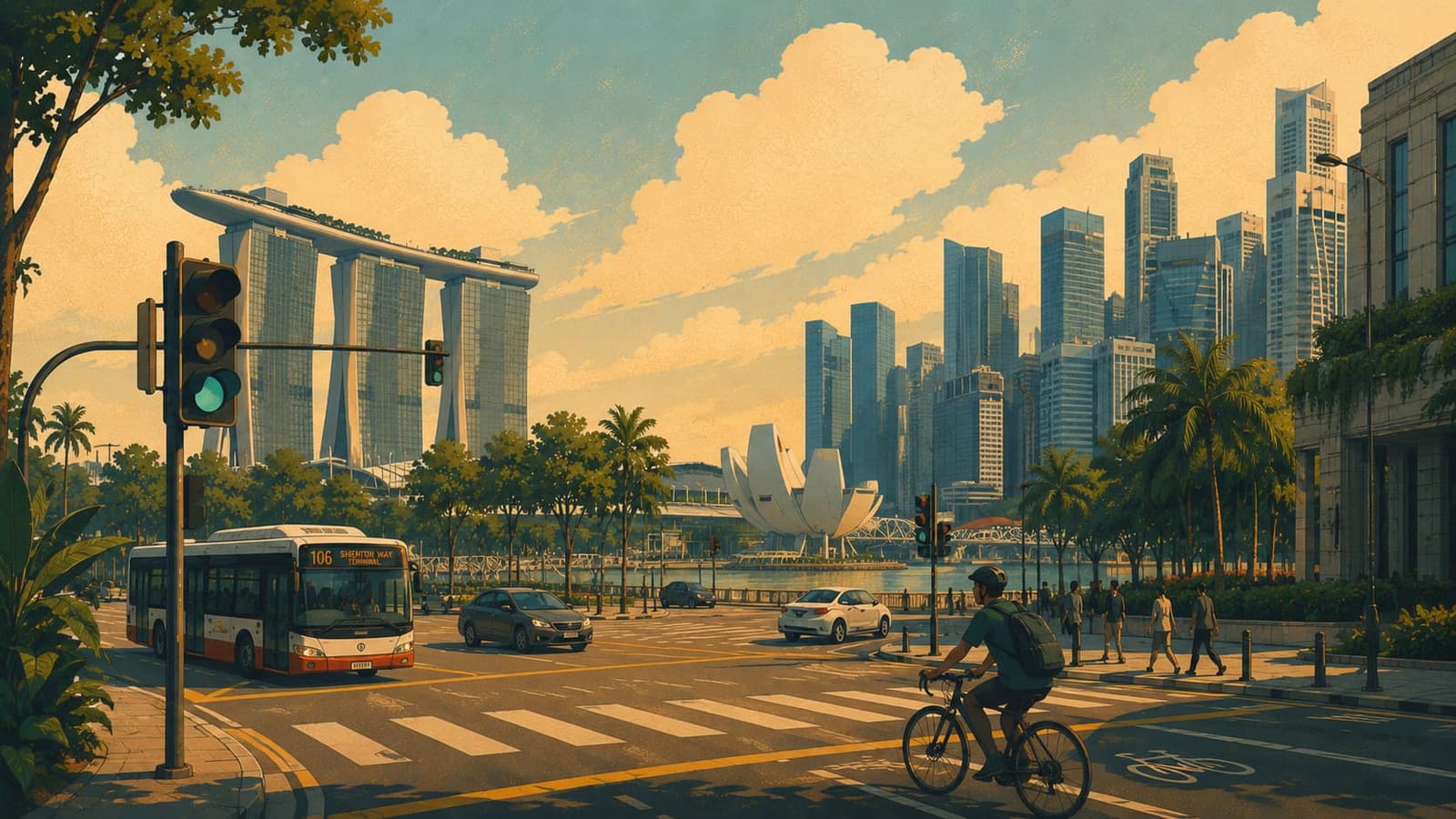
Singapore runs the smart city top-down, and has for decades. Electronic Road Pricing automated congestion charging in 1998, holding expressway speeds in a target band; the 2014 Smart Nation programme scaled that data-driven approach across government, tying together the Singpass ID used by about 97% of adults and nationwide sensor platforms. State-led, coordinated and early.
Three entries that show what Singapore is actually doing.
Computed from the 20 entries below — a profile, not a score.
Singapore's smart-city reputation predates the term. Electronic Road Pricing automated congestion tolling by gantry in 1998, holding expressway speeds inside a 45-65 km/h band for more than two decades before a satellite-based upgrade began replacing the gantries in November 2023. The same infrastructure-first instinct built Marina Bay's district cooling network from 2006, still the world's largest underground system of its kind, chilling the central business district from a shared plant rather than thousands of individual air-conditioners. Neither project called itself “smart” at launch; both simply solved a hard operational problem at national scale, a pattern the city kept repeating.
The coordinating layer arrived in 2014, when the government launched the Smart Nation Initiative to tie together the Singpass digital identity, the LifeSG services app and nationwide sensor platforms under one strategy, refreshed as Smart Nation 2.0 in 2024. The same year, agencies began building Virtual Singapore, a roughly S$73 million national 3D digital twin completed in 2022 that lets planners simulate flood risk, rooftop solar potential and crowd movement across every building on the island. A year later, the Municipal Services Office launched OneService, a single app that routes complaints about littering, pests or broken facilities to the right one of ten agencies and seventeen town councils without residents needing to know who is responsible — later gaining an AI chatbot on WhatsApp and Telegram in 2021.
Beneath the headline programmes runs a dense layer of everyday digital services. The Singpass identity (a national login since 2003, with a mobile app from 2018 and face verification from 2022) and the LifeSG super-app put government transactions and benefits behind one front door, while the Land Authority’s OneMap has served the country’s authoritative base map and open geospatial API since 2010. The state’s reach extends into health and housing: the Health Promotion Board’s National Steps Challenge has handed out free fitness trackers to hundreds of thousands since 2015, and HDB’s Smart-Enabled Home framework wires new flats for opt-in sensors — including movement monitors that alert a carer if an elderly resident’s routine breaks.
The built environment itself became a testbed. The Building and Construction Authority has certified buildings under its Green Mark scheme since 2005 and pushed toward net-zero with the SkyLab rotating high-rise laboratory and live building-energy management. After the 2010–2011 floods, PUB wired the island’s drains with a flood-monitoring network of more than a thousand water-level sensors and public alerts. And at Tengah, the country is building its first smart town from scratch — centralised district cooling, pneumatic waste and a car-lite town centre — with early residents moving in from 2023.
Not every system was built to last. When COVID-19 arrived, GovTech and the Ministry of Health built TraceTogether and SafeEntry in weeks, reaching 70% adoption by the end of 2020 on the open-sourced BlueTrace Bluetooth protocol and supporting roughly 600,000 quarantine orders. A 2021 controversy, when the government confirmed police could access the contact-tracing data for criminal investigations, prompted new legislation restricting that use — and once the pandemic passed, the city did something unusual for smart-city infrastructure: it switched the whole system off, deactivating both apps in February 2023 and deleting the collected data by 2024.
Not every bet pays off, and Singapore’s record is unusually honest about it. The Beeline crowd-sourced bus platform ran demand-shaped express routes from 2015 before being wound down in 2019; GovTech’s Lamppost-as-a-Platform sensor trial — which drew a 2018 facial-recognition privacy debate — was judged impractical to scale across 110,000 lampposts and shelved in 2023; and in January 2024 LTA’s push to move all commuters onto account-based SimplyGo ticketing drew such backlash that the government reversed course within two weeks, kept the legacy cards and called it a “judgment error.” The same instinct that switched off TraceTogether also lets the state retire what doesn’t work.
Utility infrastructure kept building in parallel. National water agency PUB layered acoustic leak sensors and analytics across the distribution network from 2016 with its Smart Water Grid, scaling toward roughly 1,200 islandwide sensors that pinpoint leaks to within a few metres. From 2019, JTC master-planned Punggol Digital District, a 50-hectare enterprise district that opened progressively from 2024 with an Open Digital Platform linking building systems, service robots and the city's first district-level smart grid.
The newest layer moves Singapore's decades-old traffic-management instinct into autonomous vehicles — fittingly, in the same district. LTA's Punggol Autonomous Shuttle Service, run jointly by Grab-WeRide and ComfortDelGro-Pony.ai under the national AV safety framework, opened to the public between April and June 2026 on three fixed routes, each still carrying a safety operator on board.
Editorial links between Singapore's own entries — the city as a system, not a list.
Plans and announced trajectories — not yet documented results.
Where Singapore appears in the atlas's own analysis.
Three cities the atlas reads next to Singapore — the reason first, then the entries it rests on. Chosen by hand from the Singapore threads below, not counted out of them.