
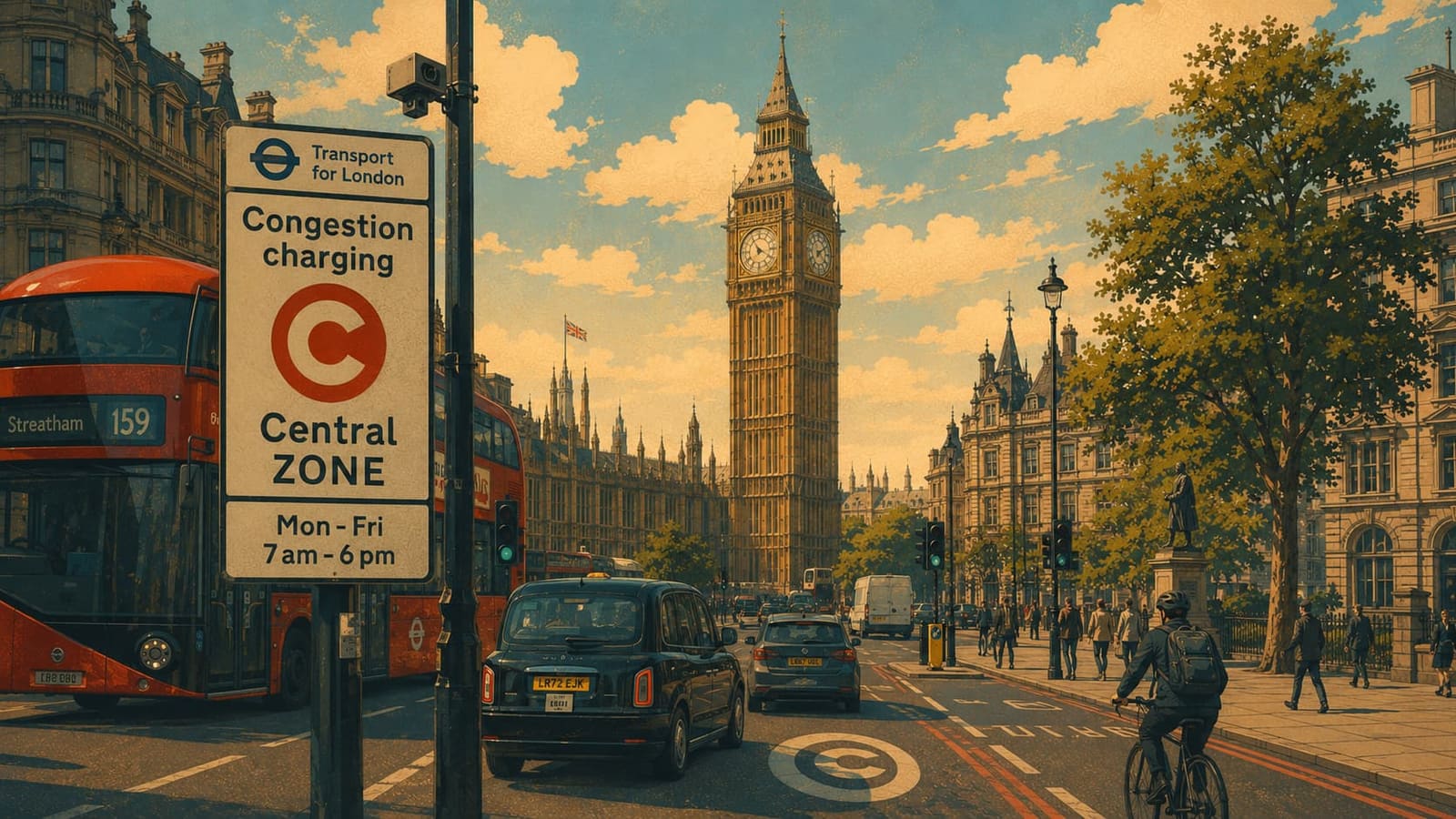
Fifty years of congestion pricing: from paper permits to satellite tolls
In 1975 Singapore charged drivers with paper licences checked by officers at 28 gantries. In 2025 New York became the first US city to price its core — and won in court. Half a century of one idea — congestion pricing, also called cordon pricing or road tolling: what worked, what voters killed, and what comes next.
On the morning of 2 June 1975, auxiliary police officers took up positions at some 28 gantry points around Singapore's business district and began peering into windshields, checking for a paper licence that cost three Singapore dollars a day. Fifty years later, almost to the season, a federal judge in Manhattan upheld New York's right to charge cars nine dollars to enter Midtown — over the objections of the White House. Between those two moments runs the most consistently measured, most consistently resisted idea in urban policy — call it congestion pricing, cordon pricing, or road tolling: charge for scarce road space, and traffic yields.
1975: the idea arrives on paper
Singapore's Area Licensing Scheme was congestion pricing with no technology at all: buy the paper supplement, display it, get waved through — or get written up by an officer standing at the cordon. The World Bank's account records the effect: by that October, car traffic entering the zone had fallen about 73%, and total peak-hour traffic about 44% (two different numbers, often conflated — the preliminary first-week counts ran even steeper for cars). It is standardly described as the world's first successfully implemented urban congestion pricing scheme, and it ran on paper and eyesight for 23 years — until the gantries of the Electronic Road Pricing system automated it in 1998.
2003–2013: Europe translates the idea, three ways
London brought road pricing west in 2003 with the bluntest possible design — a flat daily fee enforced by ANPR cameras — and cut cordon traffic about 18%. Stockholm refined both the pricing (time-of-day tariffs) and, more importantly, the politics: a seven-month honest trial in 2006, then a referendum. Traffic fell about 22% against a 10–15% target, and a public that had been roughly 70% opposed voted the charge permanent. Gothenburg then ran the replication test in 2013 — same Stockholm blueprint, and a revealing wrinkle: its 2014 referendum went about 57% against, yet the council kept the tax, and traffic stayed about 10–12% lower in charged hours. Same idea, three political grammars: impose it (London), earn it (Stockholm), weather it (Gothenburg).
The graveyard: where the idea lost
| City | Year | How it died |
|---|---|---|
| Hong Kong | 1983–85, then 1997, 2006 | Ran the world's first electronic road-pricing pilot (~20% peak reduction) — then shelved it repeatedly over privacy fears and thin consensus; never implemented |
| Edinburgh | 2005 | Postal referendum, 74.4% no — held before any trial |
| Manchester | 2008 | Referendum, ~79% no across all ten boroughs |
| New York (first attempt) | 2008 | Bloomberg's $8 plan died without a vote in the State Assembly, forfeiting ~$354M in federal funds |
The pattern in the losses is the mirror image of Stockholm's win: every rejection happened before voters had experienced the benefits. Hong Kong adds a second lesson — it proved the technology first (1983!) and still never adopted the policy, because pricing is a political product, not a technical one.
2025: New York, seventeen years later
New York's second attempt launched on 5 January 2025 — the first congestion pricing in the United States, at $9 peak for cars, itself the survivor of a bruising path: approved at $15, paused indefinitely by Governor Hochul weeks before its 2024 start, revived at the lower price nine days after the presidential election. The Trump administration's transportation department then tried to revoke the program's federal approval; on 3 March 2026 a federal judge ruled that attempt unlawful, and the program continues as of mid-2026 (an appeal remains possible).
The first-year numbers, by the MTA's own reporting: about 11% fewer vehicles entering the zone — over 73,000 fewer per day — morning rush-hour speeds at the river crossings up an average of 23%, and subway, express-bus and local-bus ridership into the zone all up. Two independent checks make the picture credible: a Cornell study in Nature measured a ~22% drop in fine particulate matter (PM2.5) in the relief zone over the first six months, and the student-built Congestion Pricing Tracker (Google-Maps data, ~2,000 data points a day) confirms big gains on most routes while honestly noting some crossings barely changed. Revenue met its $500M annual target — $518M net through November 2025 — funding transit, which is where the equity argument lands (below).
The technology arc: from eyesight to orbit
- 1975 — paper and people: licences checked visually at the cordon (Singapore ALS)
- 1998 — RFID gantries: in-vehicle units and stored-value cards deduct tolls at speed (Singapore ERP)
- 2003/2006 — cameras: ANPR reads plates, no in-car hardware (London, Stockholm)
- 2019 — pricing pivots to emissions: the same camera cordon charges by engine, not congestion (London ULEZ)
- 2027 — satellites: Singapore's ERP 2.0 retires the physical gantries for GNSS positioning from 1 January 2027 — initially keeping location-based charges, with distance-based pricing a future option. Germany quietly proved satellite road-charging at national scale two decades earlier: the LKW-Maut truck toll (2005) was the world's first GPS-positioned distance toll.
What fifty years actually prove
Support flips after people experience the charge, not before — familiarity breeds acceptability.
— the consistent finding of Jonas Eliasson's Stockholm and Gothenburg research (Transport Policy, 2011; CTS 2014)
Three lessons hold across every case. The effect is real and repeatable — five decades, five continents' worth of attempts, and every implemented scheme measurably cut traffic, from 1975 Singapore to 2025 New York. The politics have one reliable trick: sequence the experience before the vote; every referendum held cold was lost, the one held after a trial was won. And fairness is a design variable, not a verdict: the fee alone tends to be mildly regressive, but because revenue typically funds public transport, the research consensus is that who ultimately benefits depends on where the money goes — regressive in who pays, potentially progressive in who benefits.
The next chapter is already scheduled: when Singapore's gantries come down in 2027, the world's oldest congestion-pricing city will also be the first where the cordon exists only as coordinates in software — the logical endpoint of an idea that started with a man at a gantry, squinting at a paper permit. For how the underlying mechanism works, see our glossary entry on congestion pricing; for what happens when cities install the hardware without the politics, the failure patterns piece picks up the thread.
Projects mentioned
Sources
27 checkable claims in this essay are annotated — select any dotted-underlined passage to see exactly what its source says. 23 of 27 have been individually verified by the author; the rest carry AI-prepared evidence.
- Relieving Traffic Congestion: The Singapore Area License Scheme (Staff Working Paper No. 281) open source ↗
- Area Licensing Scheme open source ↗ archived copy
- Central London Congestion Charging — Impacts Monitoring, Fourth Annual Report open source ↗ archived copy
- The Stockholm congestion charges: an overview (CTS Working Paper 2014:7) open source ↗ archived copy
- The Stockholm congestion charges — 5 years on. Effects, acceptability and lessons learnt open source ↗ archived copy
- Explaining voting behavior in the Gothenburg congestion tax referendum open source ↗ archived copy
- The Gothenburg congestion charge: effects, design and politics (CTS Working Paper 2014:25) open source ↗ archived copy
- Electronic road pricing schemes in selected places (Research Office essentials) open source ↗ archived copy
- An investigation into the reasons for the rejection of congestion charging by the citizens of Edinburgh open source ↗
- Manchester Congestion Charge — reference open source ↗ archived copy
- Idea of N.Y. City traffic fee runs into dead end open source ↗ archived copy
- On Its First Anniversary, Governor Hochul Celebrates Transformational Success of Congestion Pricing open source ↗ archived copy
- Congestion pricing upheld by federal judge over Trump's objections open source ↗ archived copy
- A first look into congestion pricing in the United States: PM2.5 impacts after six months of New York City cordon pricing open source ↗ archived copy
- ERP 2.0 open source ↗ archived copy
- One Year In, Congestion Toll Yields Gains for Manhattan and MTA open source ↗ archived copy
- Congestion pricing revived after five-month pause at 40% discount, Hochul says open source ↗ archived copy
- Einführung der Lkw-Maut (1. Januar 2005) open source ↗ archived copy
- Das Lkw-Mautsystem in Deutschland open source ↗ archived copy
- Congestion Pricing Tracker open source ↗ archived copy
- Voters reject congestion charge open source ↗ archived copy
Frequently asked
What was the world's first congestion pricing scheme?
Singapore's Area Licensing Scheme, from 2 June 1975: paper licences (S$3/day) checked by officers at ~28 gantry points. By that autumn, car traffic entering had fallen about 73% and total peak-hour traffic about 44%. It ran until the electronic ERP replaced it in 1998.
Does congestion pricing (road pricing) actually work?
Every implemented scheme has measurably cut traffic: Singapore ~44% (1975), London ~18% (2003), Stockholm ~22% (2006), Gothenburg ~10–12% (2013), New York ~11% (2025, over 73,000 fewer vehicles a day). Whether it's called congestion pricing, cordon pricing or road tolling, the effect persists where prices are maintained and recalibrated.
Why do referendums keep rejecting it?
Cold votes lose: Edinburgh (74% no) and Manchester (~79% no) voted before any trial. Stockholm ran the trial first — and flipped ~70% opposition into a yes. Familiarity, not argument, changes minds.
Is it unfair to poorer drivers?
The fee alone is mildly regressive; the outcome depends on revenue use. Since proceeds typically fund public transport — as in London, Stockholm and New York — well-designed schemes can be neutral or progressive overall. Design decides.