Dubai Metro
No cab, no driver, and 89.6 km of it. The Red and Green lines carried 275.4 million riders in 2024 at 99.7% punctuality, and a third line is due by 2029.
Live
📅 since 2009
◆ Source-checked

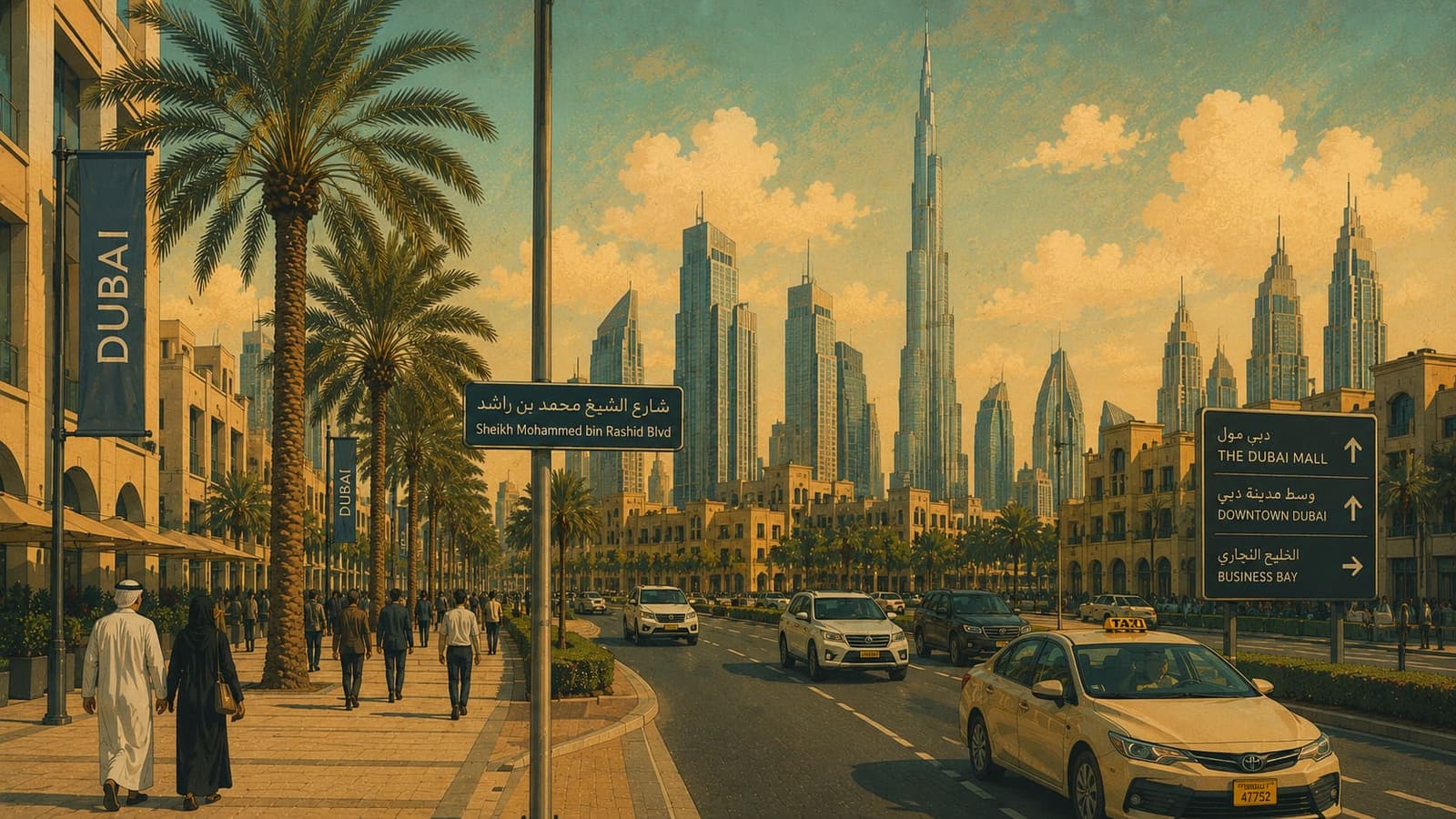
Dubai runs the state-led maximum of digital government: launched as Smart Dubai in 2014, its DubaiNow app now bundles about 370 services into one platform, and the 2018–2021 Paperless Strategy cut 336 million sheets of paper a year. The scale is real, with one honest caveat this atlas applies consistently: the headline numbers are self-reported, not independently audited.
The atlas documents 12 projects in Dubai, the earliest dating to 2009: 3 with a documented success, 1 documented failure, 8 still running without a verdict. Every entry carries an evidence grade — the strongest here is official (9 entries) — and links its sources.
Three entries that show what Dubai is actually doing.
Computed from the 12 entries below — a profile, not a score.
Dubai's smart layer started as automated backbone infrastructure, years before anyone called it that. Dubai Metro opened in September 2009 as a fully automated GoA4 driverless system — for years the world's longest driverless metro network — while Salik's barrier-free RFID road tolling, running since 2007, removed staffed toll booths years before congestion pricing became fashionable elsewhere. Both ran quietly for a decade before any strategy document used the word "smart."
From 2013 the emphasis shifted to a deliberate, state-led push across every domain at once. DEWA began building the utility-scale Mohammed bin Rashid Al Maktoum Solar Park that year, growing to 3,860 MW by 2025; in 2014 Smart Dubai (now Digital Dubai) launched as a single government-services umbrella that eventually bundled around 370 services into the DubaiNow app. DEWA opened a distributed option to residents in 2015 too: the Shams Dubai net-metering scheme let homes and businesses feed their own rooftop solar into the grid, reaching over 725 MW by 2025. In 2017 Dubai Police applied the same instinct to policing itself, opening the world's first unmanned, self-service police station — the pattern throughout was removing the counter, not adding a screen to it.
The less visible utility work kept running in parallel. DEWA replaced Dubai's electricity and water meters with over two million smart meters between 2015 and 2020, then added a self-healing grid restoration system in 2022 that isolates faults and reroutes power within milliseconds — by 2025 it had helped cut the average customer's annual time without power to a record 49 seconds. Not every bet landed: RTA's 2018 autonomous pod and shuttle trials — a Next Future NX1 pod demonstrated for Sheikh Mohammed bin Rashid and a multi-phase EasyMile shuttle pilot — generated headlines but no lasting service, leaving an eight-year gap before autonomous mobility returned for real.
That return came in 2025 and 2026, alongside a wave of upgrades to decade-old infrastructure rather than fresh builds. Salik switched from a flat toll to dynamic peak/off-peak pricing in January 2025; RTA's driverless robotaxi service, running Baidu's Apollo Go and WeRide fleets, went commercial in March 2026, extending the automated-transit logic of the 2009 metro onto city streets; and the 2009-era nol transit card is now mid-way through an AED 550 million shift from a closed-loop card to open bank-card and digital-wallet payment, targeted for completion in early 2027.
.jpg?width=1280)
On a time axis, by the year each one started — 2009 to 2026. Pick a dot to read what it was.
✔ Every published entry is checked against the public sources it cites before publication.
Editorial links between Dubai's own entries — the city as a system, not a list.
Plans and announced trajectories — not yet documented results.
Dubai's next few years are about whether its infrastructure upgrades land on schedule rather than about new pilots: the nol payment overhaul must clear its final phase by early 2027, and RTA's public target of a quarter of all trips running autonomously by 2030 depends on the robotaxi service scaling well past its opening fleet of about 100 cars. The self-reported nature of most of these figures — DEWA's outage minutes, RTA's transaction and ridership counts — remains this atlas's one standing caveat on Dubai: real and consistently improving, but not independently audited.
Where Dubai appears in the atlas's own analysis.
Two cities the atlas reads next to Dubai — the reason first, then the entries it rests on. Chosen by hand from the Dubai threads below, not counted out of them.
The same emirate-scale bet placed twice: two government super-apps bundling hundreds of services behind one gateway, and the same robotaxi vendor running a fenced zone in each — Jumeirah on one side, Yas Island on the other.
Two governments that answered the app question the same way and the driverless one differently: each bundles hundreds of services behind one gateway, but Beijing issued a fully driverless permit where Dubai's zone still carries a person.
Every editorial link from Dubai's entries into another city, strongest first. Each one is a statement about two projects, not about two cities — the three above are the ones the atlas is willing to make at city level.
1001 Smart Cities (2026). “Smart-city projects in Dubai, United Arab Emirates.” The Smart City Atlas. https://1001smartcities.org/cities/dubai/ (last verified 2026-10-05). Data: CC BY 4.0.
The underlying data is free to reuse with attribution — see the open data page.