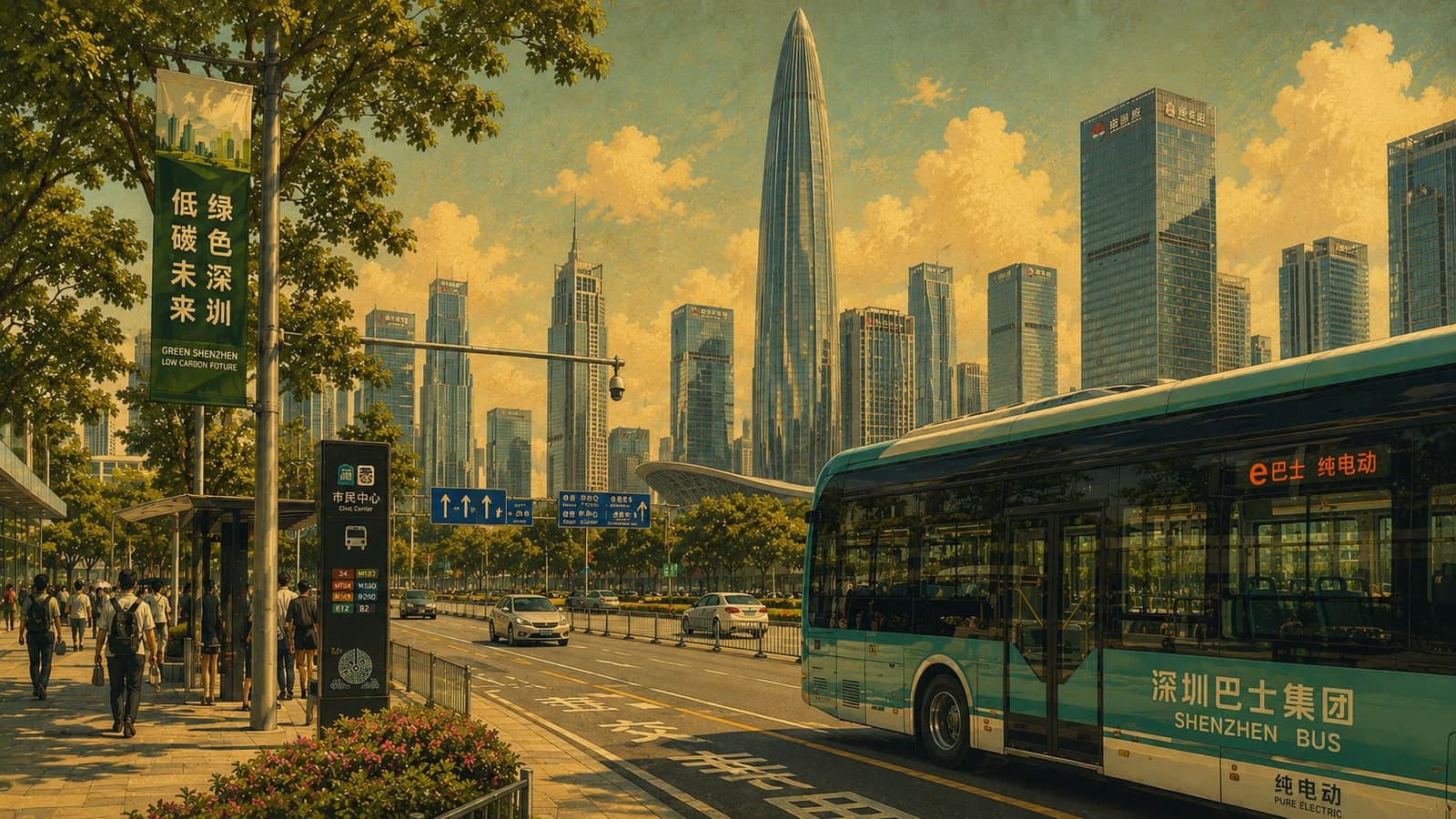
Shenzhen does the smart city at both fleet and city scale. In 2017 it became the first city to fully electrify its buses — over 16,000 of them — a feat it frames as procurement and charging infrastructure, not new technology. Now Tencent is building the car-free Net City on reclaimed land, first zones open since late 2025: one city betting on both clean fleets and built-from-scratch districts.
Three entries that show what Shenzhen is actually doing.
Computed from the 11 entries below — a profile, not a score.
Shenzhen's smart-city record starts with two unglamorous firsts. Yantian's container terminal automated its truck gates in 2016, years before automated ports made headlines elsewhere. In 2017 the city swapped its entire bus fleet — more than 16,000 vehicles — for electric ones, treating it as a procurement and charging problem rather than a technology one. Both moves share a pattern that recurs through the city's later projects: infrastructure first, headline claims later.
2019 was the year several municipal bureaus moved in parallel. The Industry and Information Technology Bureau signed the three state carriers to a 45,000-base-station 5G target, and the Bureau of Government Services and Data Management launched the "i深圳" app, folding thousands of agency services into one login. The city also finished eliminating 159 "black and odorous" waterways and then built the sensor layer to keep them that way — roughly 6,000 monitoring stations feeding a platform that traces illegal discharges back to a specific address. By August 2020 the carriers hit their 5G target, 46,000-plus base stations, ahead of schedule, and Yantian added remote-controlled quay cranes on top of its 2016 gate automation.
The next wave built on that groundwork district by district. Qianhai Authority's own tech arm began modelling the district's utility tunnels and pipe network in 3D from 2020, live today only in its core blocks. Shenzhen Metro opened two fully unattended lines — Line 20 in December 2021 and the 50km Line 14 in October 2022 — the rare case in this atlas where an outside certifier, TÜV Nord, confirmed the driverless claim rather than the operator alone. In August 2022 Shenzhen passed China's first dedicated law for autonomous vehicles, the legal scaffolding the next stage would need.
What that scaffolding enabled shows up in the sky and on the street. Commercial drone delivery, tested by Meituan from 2021, got a national aviation regulator's certification for Shenzhen's dense urban airspace in 2023; by 2025 the city had opened 310 routes and logged over a million cargo flights. On the ground, Pony.ai and taxi operator Xihu Group won Shenzhen's first citywide permit for fully driverless robotaxis in October 2025 under the 2022 law, and by February 2026 that fleet had reached unit-economics breakeven — a rare case of a robotaxi programme actually paying for its own vehicles. Tencent's Net City, still under construction on reclaimed land, remains the city's most visible bet on building a district from scratch rather than retrofitting an existing one.
Editorial links between Shenzhen's own entries — the city as a system, not a list.
Plans and announced trajectories — not yet documented results.
Two threads stay open. Yantian's newer, fully automated East Port berth complex is structurally complete but still not operating — independent trade press puts the opening at end of 2026, a reminder that "automated port" headlines often describe capacity being built, not capacity in use. Shenzhen's own regulatory head start didn't fully insulate it from national swings either: a months-long nationwide robotaxi-permit freeze in April–June 2026, triggered by an unrelated Baidu outage in Wuhan, briefly paused new approvals even in a city with an established citywide permit. Two further candidates stayed in the review queue this run: a tax-data-driven corporate carbon-account platform, held back for its thin, pilot-scale evidence, and a decade-old facial-recognition traffic-enforcement system, held back because no source could confirm it is still running as described past 2019.
Where Shenzhen appears in the atlas's own analysis.
Three cities the atlas reads next to Shenzhen — the reason first, then the entries it rests on. Chosen by hand from the Shenzhen threads below, not counted out of them.