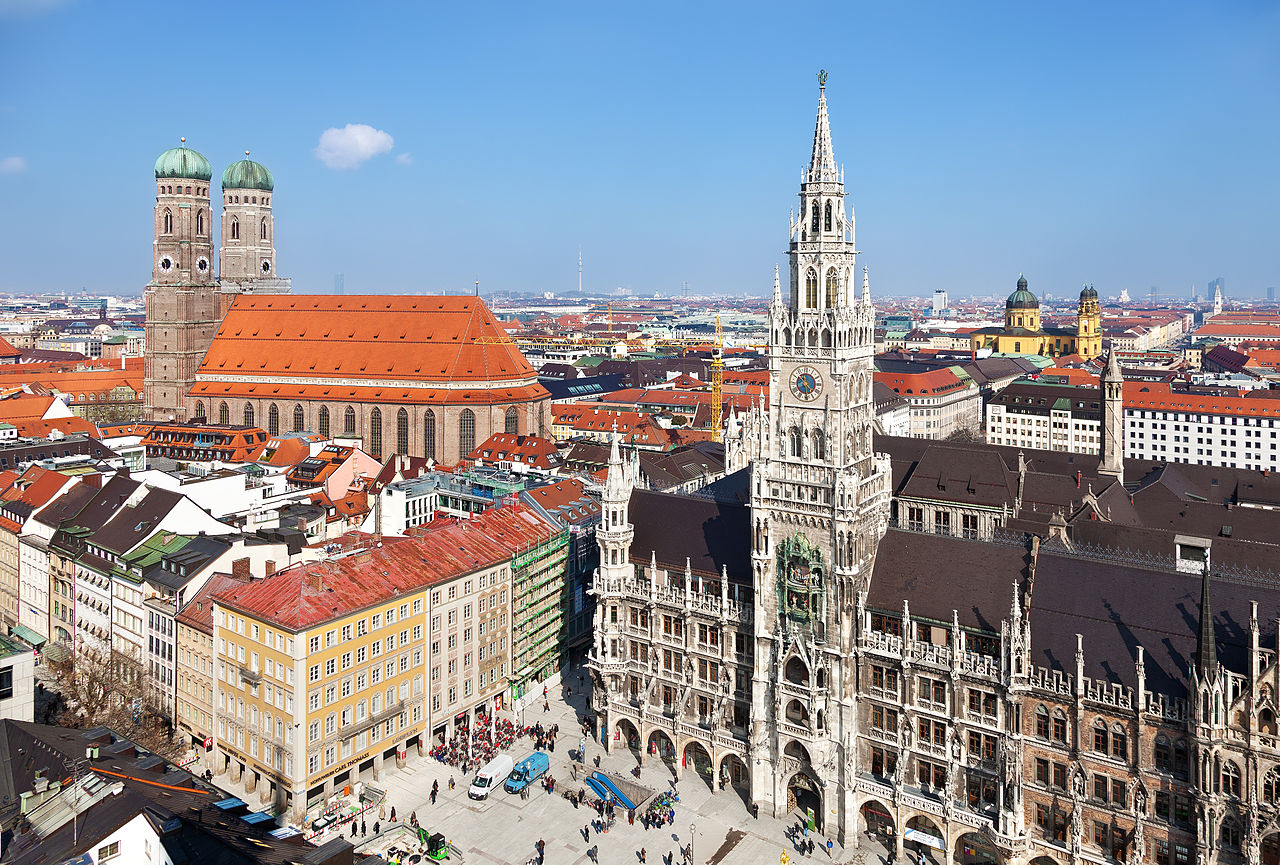
Three entries that show what Munich is actually doing.
Computed from the 7 entries below — a profile, not a score.
Munich's smart-city record starts with three quiet, unconnected pieces of infrastructure rather than one flagship launch. The city's CKAN-based open data portal went live in 2014; MVG, the transit operator, launched its own station-based bike-share, MVG Rad, the following year; and by 2018 the municipal utility SWM had built a citywide LoRaWAN radio network that would later carry groundwater-level and substation telemetry. None of the three were framed as "smart city" projects at the time — they were a data portal, a bike scheme and a utility radio network, each solving its own problem.
2019 brought the first genuinely city-scale digital-infrastructure bets. Munich began its 3D digital twin, DZ-M, under a federal clean-air programme that year, pairing a photorealistic mesh with a lane-accurate model of every street and bike path for planning use. In the same year the city council adopted the rule-based signal-switching strategy behind what is now LAPW, aiming to retime traffic lights across the network using live detector data rather than fixed schedules. Both were long builds: the twin became a permanent city task in 2020, and LAPW's rollout to all 650 targeted signals wasn't confirmed complete until a city report in January 2025. Between 2016 and 2021, Munich also ran its own slice of the EU's Horizon 2020 lighthouse programme, Smarter Together, retrofitting the Neuaubing-Westkreuz district with smart lampposts and mobility stations whose measured energy savings outlived the EU funding.
The consumer-facing layer consolidated later and less smoothly. MVG's separate apps for journey planning and car-/bike-sharing were folded into one platform, MVGO, in February 2022, and MVGO absorbed the older MVG Fahrinfo journey planner in August 2024. That consolidation then collided with the end of MVG Rad's planned ten-year run: the bike-share retired on schedule on 30 September 2025, leaving MVGO without a bike-share option for more than seven months until the regional successor, MyRadl — a different, tendered operator running the same station-based model across 36 municipalities — launched on 7 May 2026.
By mid-2026 the pieces read as more integrated than they were built to be: MVGO passed two million registered users in June 2026, the same month Munich was named Germany's top-ranked city in the Bitkom Smart City Index for the third year running. But the atlas's own fact-check found real limits behind the headline numbers — SWM's LoRaWAN-based container-fill sensors never grew past pilots of 20 and 80 units despite a stated goal of up to 1,000, and no independent evaluation exists yet for MVGO's usage claims or MyRadl's first months. Munich's strength so far is coverage and consolidation, not independently audited impact.
Editorial links between Munich's own entries — the city as a system, not a list.
Plans and announced trajectories — not yet documented results.
The nearest open question is whether MyRadl, barely three months old and run by a different operator (nextbike, under a Europe-wide MVV tender) than MVG Rad ever was, reaches the roughly 4,400-bike, 300-station scale its predecessor built up over a decade — and whether it shows up with independently verifiable ridership data rather than operator press releases. SWM's LoRaWAN network faces a similar test: its gateway count and waste-sensor pilots haven't been re-confirmed since 2022, so the next round of city reporting will show whether those pilots ever scaled past a few dozen containers or quietly stalled. On the infrastructure side, LAPW's rollout to all 650 targeted signals is now complete, which shifts the interesting question from coverage to effect — no city report yet measures whether load-dependent signal switching actually cut travel time or emissions citywide.
Where Munich appears in the atlas's own analysis.
Two cities the atlas reads next to Munich — the reason first, then the entries it rests on. Chosen by hand from the Munich threads below, not counted out of them.